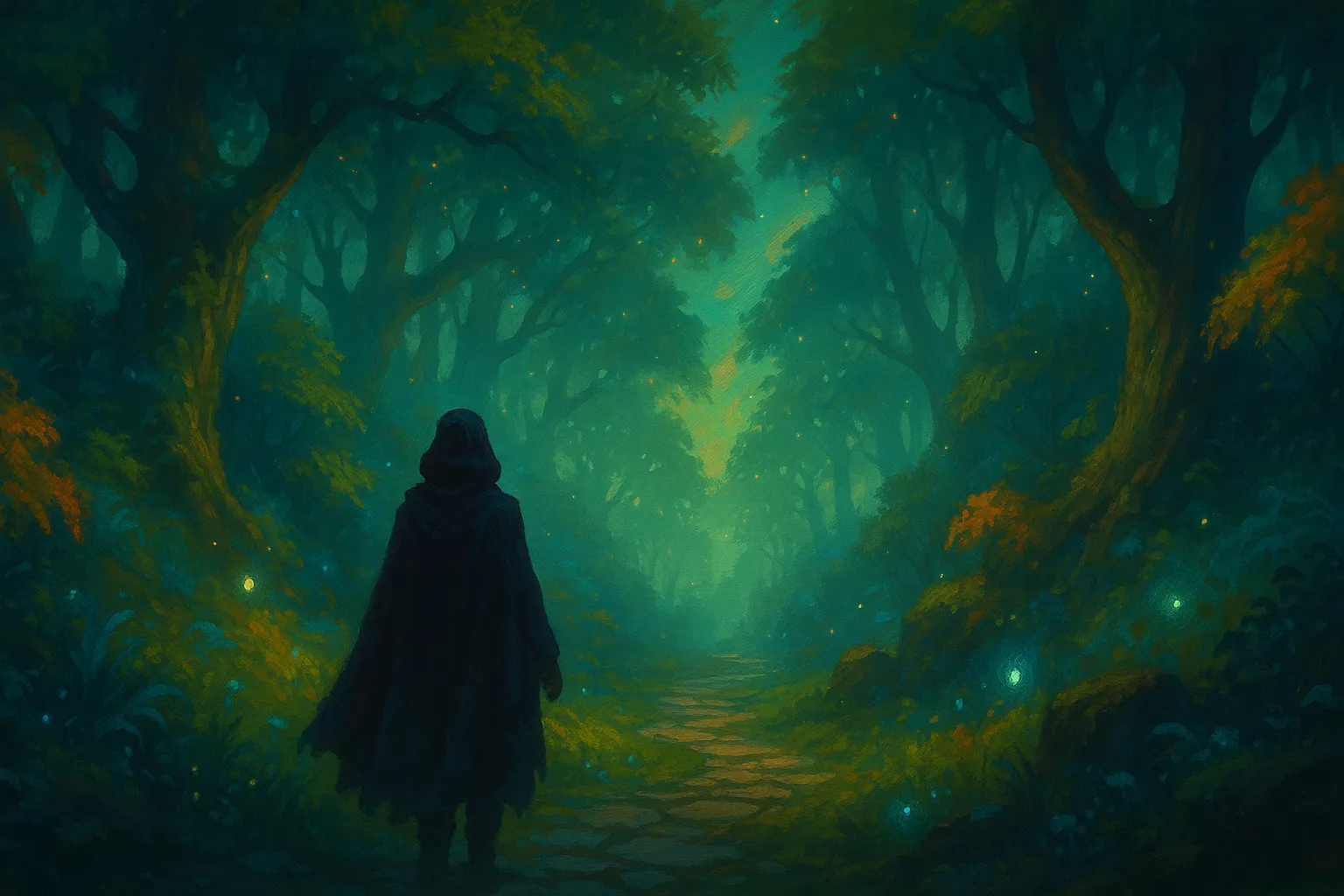
The Coincidence
Deity of Chance, Change, and the Ruined Plan
The Coincidence is frequently mistaken for a god of luck, and its clergy have stopped correcting people.
It is not interested in fortune, good or bad. It is interested in the fact that nobody is driving. Every scheme of sufficient size eventually meets a stray dog, a wrong turning, a letter delivered to the wrong house, and comes apart—and the Coincidence regards this not as a flaw in the world but as its single most important safety feature. A world where plans reliably succeeded would belong, permanently, to whoever planned best.
So it fouls things. Not maliciously and not in anyone's favour. It fouls the good plan and the wicked one with the same indifference, and its followers understand that they are as likely to be the ones tripped as the ones stepping over.
This is the position the Concordant finds hardest to answer, because the Coincidence is not arguing that arrangement is wrong. It is arguing that arrangement works, which is the problem.
Domains:
- Chance: Genuine uncertainty, treated as sacred. The Coincidence's power gathers wherever an outcome is not yet settled and dissipates the moment it becomes a foregone conclusion.
- Change: The refusal of any state of affairs to persist. Not progress, which has a direction—simply motion, in whatever direction happens to be available.
- The Ruined Plan: The specific and beloved moment when something carefully arranged encounters something nobody accounted for.
Manifestation and Symbols:
- The Coincidence is depicted differently in every shrine, deliberately, and congregations that drift toward a consistent image are required to change it.
- Its sigil is a die mid-throw, never shown landed. Depicting a result is considered a minor blasphemy and a fairly serious joke.
- Its presence is felt as the intrusion of the irrelevant. The unrelated fact that turns out to matter. The stranger who asks the one question the plan did not survive.
Doctrine and Influence:
- "A world that can be steered has an owner."
- The founding argument, and the one aimed squarely at the Concordant. Unpredictability is not disorder but the absence of a master.
- "Do not pray for a good outcome. Pray that it is still open."
- Followers ask for uncertainty rather than success, which makes their prayers unusually easy to grant.
- "It will fall on you too. Laugh anyway."
- The faith requires its adherents to accept being on the receiving end. A follower who curses their own bad luck is held to have misunderstood the entire position.
Worshippers:
- The Cult of Dy, the Coincidence's oldest and most visible church, whose trial-by-chance practices are either profound or appalling depending on who is on trial.
- The Uncertain, its political bloc, distinguished by an unwillingness to commit that its opponents call cowardice and it calls doctrine.
- Gamblers, of course—though the devout ones are notable for playing badly on purpose.
- Anyone who has been saved by an accident, a congregation that recruits itself.
Rituals and Ceremonies:
- The Cast: A decision of real consequence handed to a die, and abided by. The faith is explicit that this is not a way of finding the right answer but of refusing to be the one who chose.
- The Wandering: A journey undertaken with the route decided at each junction by chance, for as long as provisions last.
- The Spoiled Feast: An elaborate celebration planned in exhaustive detail and then, at the last moment, deliberately disrupted by an outsider paid to invent the disruption.
Sootgrove
The Coincidence's domain on the Concordant Tread is Sootgrove, a chaotic trialland where roads shift by the throw and justice arrives spectral and erratic. It is one of the few domains of the Nine that can be entered at all, which the Coincidence's rivals attribute to carelessness and its followers to the obvious fact that a domain nobody can reach cannot ruin anyone's plans.
The Coincidence is not a god of fortune but of the open question—indifferent to how things turn out, devoted to the fact that it was not yet decided.
"Someone was going to control everything. I made sure the dog got out."